


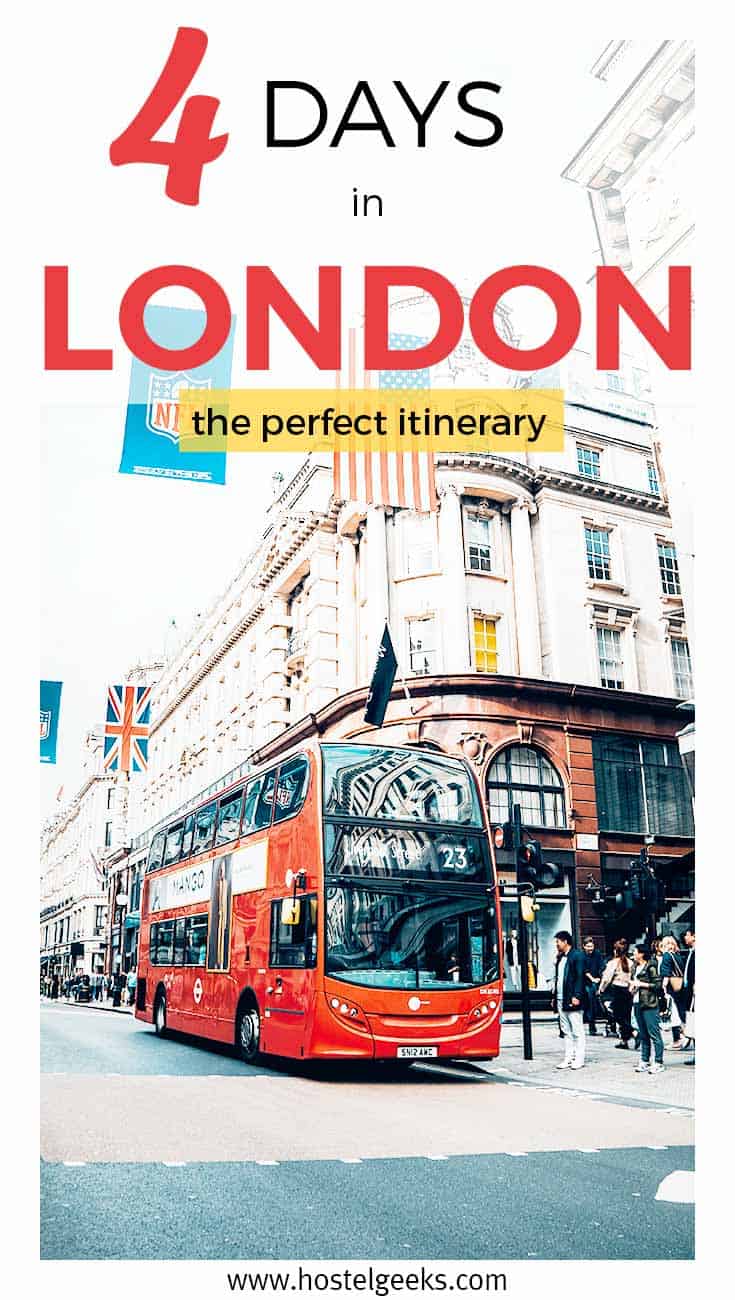
 London is the kind of city where four days feels like plenty right up until day three. Then you look at the map and realise you’ve barely touched it.
That’s the tradeoff. Four days won’t show you all of London. Nothing will, honestly. People live here for years and still find streets they’ve never walked down.
But four days is enough to see the big sights, eat well, ride the top deck of a few buses and get a feel for how the city works. Got a week or a month? Great, stretch this out. If not, this is the version that doesn’t have you sprinting between landmarks.
Not sure which part of town to base yourself in? This guide to where to stay in London breaks it down by budget and location. For hostels specifically, Hostelz has a guide on where to stay in London for the first time.
What can you do in London within 4 days in order to have the perfect trip?
We’ll assume you landed yesterday, slept it off, and day one starts the moment you wake up.
On a tight budget, walking is your best friend here. Before any of that, though, sort out your bed. Hostelz compares prices across the booking sites, so it’s a quick way to see which of these is cheapest for your dates.
The top hostels in London are:
- Onefam Notting Hill (formerly Hostel One Notting Hill) – best for backpackers
- Destinations Hostels @ The Gallery – best for a very British atmosphere
- Wombat’s City Hostel London – best for solo travelers
Read: full guide to 3 best hostels in London
Do as much of the city on foot as you can. The free walking tours are a good start, and you get more of the actual city from a local guide than from a bus window. For something more specific, look at the tours from Walks of Italy and Airbnb Experience.
Right. Here’s how the four days go.

Day 1: The City of London
Day one starts at St. Paul’s tube station and covers a big chunk of the old city.
Get there early. St. Paul’s Cathedral fills up fast once the tour groups arrive, so check the opening times the night before and aim to walk in close to opening.
Inside you’ve got the Duke of Wellington monument, the Stone and Golden galleries, and the chapels. The climb to the galleries is a lot of stairs. Worth it anyway.
Give the cathedral an hour or so, then walk across the Millennium Bridge (yes, the one from Harry Potter) and follow the river east towards the Tower of London.
Spend the late morning at the Tower. This is where the British history lesson really lands, and the Crown Jewels are inside. Afterwards, cross Tower Bridge. Best photos of the day, probably.
By now you’re hungry, and Borough Market is just over the river. It’s London’s biggest food market.
Traditional British stuff, food from half the world, all under one roof.
In the afternoon, head to Covent Garden for the street performers, then Hyde Park for a slow walk or a go on the boats. Dinner at the West Yard.

Day 2: The Museums
Museum day. The Natural History Museum, the Victoria and Albert Museum and the British Museum.
Here’s the good part: the Natural History Museum and the British Museum are free.
Between them you get human history, the animal kingdom and space exploration, and you’ll learn more than you expect to. The café at the Natural History Museum does a British breakfast too, if you skipped yours.

Two museums in and it’s roughly lunchtime.
Watching your money? Kebab shops and the other cheap ethnic places are where you eat and drink for very little in this city.
Or, if your hostel has a kitchen, make something to take with you. It adds up over four days.
Then spend the afternoon on Carnaby Street or Oxford Street. Window shopping counts.
Finish with dinner at Opium Dim Sum.

Day 3: Indulge in British Royalty
Buckingham Palace first. The royal family has called it home for over 170 years.
Come for the Changing of the Guard. It happens late morning, but not every day, so check the schedule before you go and get there a good while early if you want a spot near the railings.
In summer you can book a ticket to see inside the State Rooms. Or don’t. Watching the ceremony from outside costs nothing, and plenty of people are happy with that.

Before lunch, walk through St. James’s Park (it’s lovely), see Westminster Abbey, which is close to a thousand years old, ride the London Eye and stop on Westminster Bridge for photos. It’s a full morning. You’ll feel it in your legs.
Lunch and afternoon tea at Wallace. The food is good and it won’t wreck your budget.
More of a coffee person? Here are 10 cute coffee shops in London.
After that it’s your call: a few London pubs, or an afternoon tea river cruise.


Day 4: A Tour to the Outskirts
Last day. Some of London’s suburbs could pass for small cities of their own, and it’s nice to see one.
Go to Greenwich. The parks, pubs and restaurants are calmer than anything in the centre, and after three busy days that’s a relief.
This is where you learn about the Meridian line and how it sets time for the whole world.
You can also stand with one foot in the eastern hemisphere and one in the western, and look around the Cutty Sark.
Eat lunch at one of the restaurants around the Meridian.
In the afternoon, take a bus out to Chislehurst for the Chislehurst Caves. Or go ice skating, or climb over the roof of the O2 arena.
Bottom line
London has more than four days can hold. With a flexible budget you’ll run out of time long before you run out of things to do. Don’t be surprised if a fifth or sixth day sneaks onto the trip.
BONUS TIP: THE BEST MARKET
Whatever else you do, go to Borough Market.
I spent my first few months in London going to every market I could find.
There are loads, and roughly they go like this:
- the touristy: Spitalfields, Camden
- the not-so-touristy: Petticoat Lane
- the posh: Portobello
- the uber-posh: Greenwich
I’d go back to any of them.
Borough is still the one I’d send you to twice. The food is ridiculously good, and for a market squeezed under railway tracks it’s surprisingly beautiful.
It also slots neatly into our one-day walking tour of London.
Budgeting your 4 days London Itinerary
Money is the hard part. London isn’t cheap, and there’s no point pretending otherwise.
Eating out and paid attractions are where most of a traveller’s daily spend goes in London.
For a typical traveller, the money splits roughly like this:
- Eating out: the biggest daily cost
- Entertainment (bars, tours & attractions): the next biggest
- Transport: smaller, especially if you stick to buses
- Shopping: optional, and not something you do every day
That’s a middle-of-the-road budget. Not high-end, not living on a shoestring either. Most of the major sights, a few cab rides, maybe one big night out and a bit of shopping.
Accommodation and car hire aren’t included, since you’ll usually book those in advance.
This itinerary comes in cheaper than that.
Lean on the free museums and attractions, be smart about transport, and you can
Travel on a budget and still do London properly
Add more paid activities and the number goes up, obviously.
Most of the fun costs something, though: bars, shows, the odd museum that charges.
Most visitors head straight for the centre when they want a night out.
The West End (Soho) has a great buzz, sure. But Angel, Notting Hill, Camden and Dalston are good alternatives, with plenty of bars, fringe theatre and other stuff going on.
A few ideas, free and paid:
- The London Eye (at Airbnb Experience): paid
- Sherlock Holmes Experience: paid
- British Museum: Free
- Southbank Centre: Free
- The Comedy Store, Leicester Square: paid
- Evensong at St Paul’s Cathedral: Free
- West End Show: prices vary

Tips for visiting London on a budget
Decide What Time of Year to Visit London
London weather is unpredictable. Plenty of Londoners carry sunglasses and an umbrella all year, and they’re not being dramatic.
It never gets extreme enough to ruin a trip, though, and the big attractions aren’t seasonal.
Visitor numbers jump in July and August, usually the hottest months. The shoulder seasons in spring and autumn, outside the school holidays, are a good time to come if you’d rather skip the crowds.
School holidays fall in February, at Easter, in August, in October and at Christmas.
Travel Document Requirements for London
Every overseas visitor needs a passport, and depending on where you’re from you may need a visa or an electronic travel authorisation (ETA) before you fly. Check the UK government site for your nationality. US citizens can also register their trip with the US Department of State.
Arriving in London
You can reach London by air, rail, road or ferry.
Which one makes sense depends on where you’re coming from and how much time you’ve got.
Flying in?
Here’s our latest booking flight hack for finding cheaper fares.
Public transportation
Public transport here is good, and buses and the tube are fairly priced. One thing to know: buses don’t take cash.
Use an Oyster card or a contactless bank card, and stick to the same one every time you tap. That way you get the daily cap, and once you hit it the rest of the day’s travel is free. Buying single paper tickets costs a lot more.
Switch between cards or pay in different ways and you lose the cap.
If you go contactless, check first that your card works without foreign transaction fees eating the savings.
Timing matters too, not just for the season but for the hour.
Weekday rush hours are peak time on the tube, early morning and late afternoon. Travel outside those windows and you pay the cheaper off-peak fare, plus you might actually get a seat.
Cars drive on the left. Look the right way before you cross!
And don’t drive in London. Outside the city it’s fine. In it, just don’t.
One more way to save money and skip some queues: the London Pass.
It’s a sightseeing card that gets you into a long list of London’s top attractions without paying at the door.
You pick how many days it covers, and while it’s valid you can go into as many of the included attractions as you can fit in. Whether it pays off depends on how many paid sights you’d visit anyway, so do the maths first.
What you get with it:
- Entry to a long list of attractions (including the Tower of London, Kensington Palace and Westminster Abbey)
- Fast-track entry at some of the popular ones
- Hop-on hop-off bus tour
- Money-back guarantee
There is never a good reason to take a cab
The Underground is easy to figure out, and late at night there are buses.
Okay, buses can be a pain. Going from Brockley to Liverpool Street at five in the morning, a bit drunk, with two changes, is not fun. But they cost a fraction of a cab, and the top deck of a double-decker is a great seat for watching the sun come up over London.

Things to know before visiting London
Know the lingo
Yes, they speak English. Still, the slang will catch you out now and then.
Money, for example:

Brits usually say “pee” instead of pence, as in 25p (25 pee). A pound is a “quid”, a five pound note is a “fiver” and a ten pound note is a “tenner”.
A few more you’ve probably heard but are worth knowing:
- Loo = bathroom (toilet is also acceptable)
- Cheers = thanks
- Lift = elevator
- Queue = line
- Bin = trash
- Boot = trunk (used in the context of a car)
- Fag = cigarette
- Cashpoint = ATM
- Trainers = tennis shoes
- Zebra Crossing = Pedestrian Crossing
- Chemist = Drug Store
- Biscuit = cookie
- Chips = french fries
- Crisps = chips
- Ground floor = first floor
- Petrol = Gas
Football games
Yes, this itinerary covers football too. Go to a game, even if you couldn’t care less about the sport.
The crowd singing alone makes it worth the ticket.
It’s nothing like any sporting event I’ve been to in the US.
And watching the players up close might give you a new respect for how much fitness and skill the game takes.
Secret bars in Shoreditch
Shoreditch is one of London’s trendiest neighbourhoods.
It’s full of bars, secret hangouts and hidden clubs, which makes it a good bet for a night out.
Wander around and look for the bars that are tucked out of sight. Some of them even want a password at the door.
Currency – Pounds or EUR?
Pounds. London uses the British pound, not the euro.
Tipping: some restaurants and cafés add a service charge to the bill, sometimes 12 percent or more. If they don’t, 10 to 15 percent is normal, especially in a sit-down restaurant.
In a pub or wine bar, tipping is up to you.
In a cab, round up to the nearest pound or give about 10 percent.
Most restaurants and shops take the major cards.
Safety
London is a pretty safe city overall. Two things to keep in mind, though:
- Official cabs
The U.S. State Department advises tourists to use only London’s licensed black cabs. Unlicensed cabs and private cars pretending to be taxis have ripped off, mugged and even assaulted passengers. If you need a car, book it directly with a taxi company (your hostel or hotel can help).
- Pickpockets
Watch out for pickpockets.
Like every big city, London has them. They go for tourists on the Tube and around the big sights, Big Ben especially.
Culture & Customs
Apart from a handful of words and phrases, English speakers will find London easy to get around.
Brits are polite and generally friendly to visitors, so don’t be shy about asking for directions.
More often than not, a Londoner will point you the right way, and might throw in a recommendation too.
But the British like order.
The Tube (London’s subway) is the best example. Stand on the right on escalators. Seriously, people will notice.

The other side of the Brits, young adults especially, is how much they like a drink.
Where Americans meet at a coffee shop, Brits meet at the pub.
Most pubs serve food and stay open most of the day, so don’t be surprised to see families with small kids walking in.
Around 5pm the after-work crowd arrives, and pubs and bars fill up all week. In the warmer months you’ll see big groups standing outside with their pints, and a few people stumbling out by 9pm.
London is also one of the world’s fashion capitals, so you’ll see locals dressed up all over town, especially around Oxford Street, where a lot of fashion houses and magazines are based.
Ever wanted to make an effort with your outfit? This is the city for it.
Day trips from London
One of the best things about London is how easy it is to leave.
I love London to death. I just wish I’d realised sooner how many great places are a short train ride away.
Brighton, a lovely seaside town, is about an hour by train.
Small, very British towns like Windsor and Henley-on-Thames are even closer.
Even a quick overnight in Edinburgh is doable (though you’ll want more than a day there, to be honest).
The UK is much easier to get around than the United States. If I could do it again, I’d skip that extra day on the South Bank and see more of the country instead.
Summary 4 days in London Itinerary
So, is that enough to plan your four days in London? Stretch it to five or even seven if you can. The ideas above will hold up either way.
Want more?
Here’s what else we’ve written about London:
And if you feel like splurging, how about a cute boutique hotel in London?
Your daily budget will go up. Then again, you’ve got plenty of ways to save it back.
Safe travels,
The Hostelgeeks
– – –
pin it now, read it later